Reihax product
FOCUS
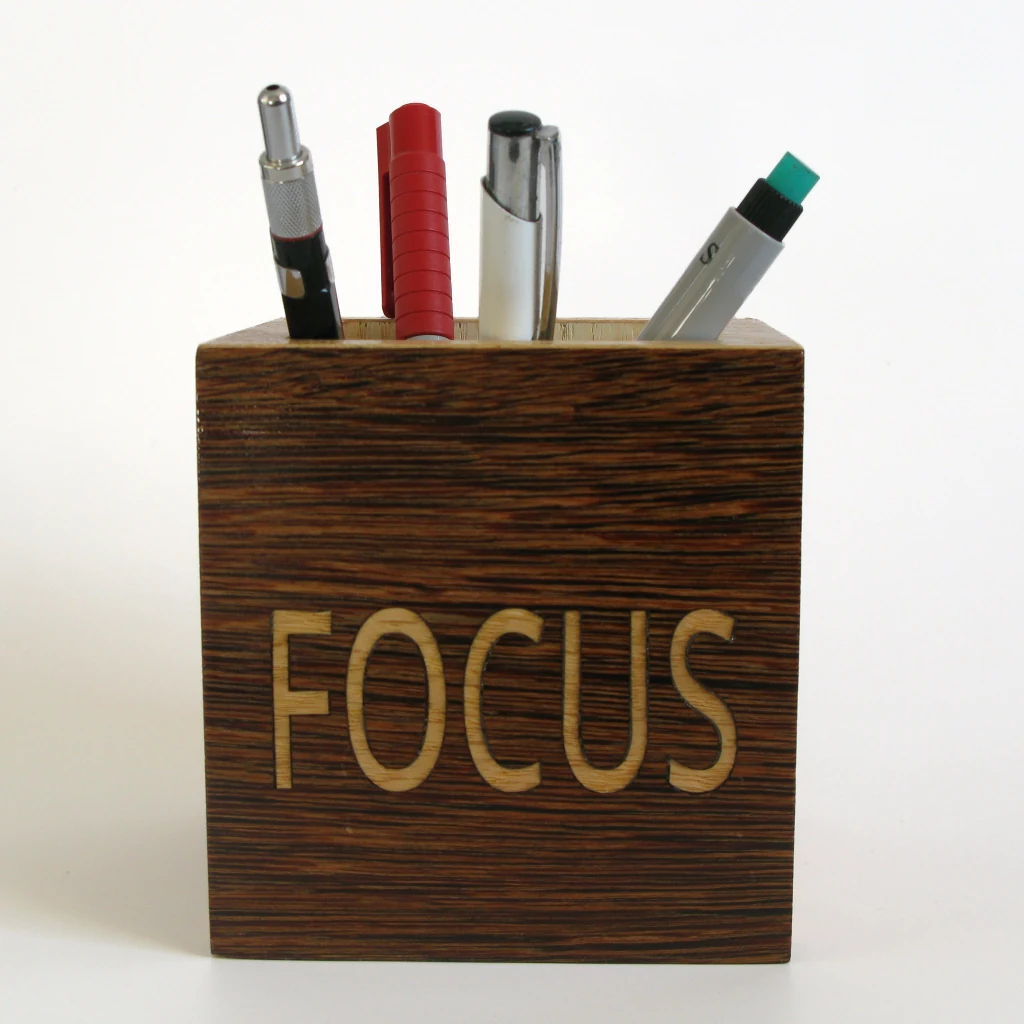
A handmade pen holder in intarsia. Real wood veneer, no print. The word FOCUS and a cell pattern are made from two woods, fitted, pressed, sanded and finished one at a time. FOCUS is a precision object for the desk.
What FOCUS is
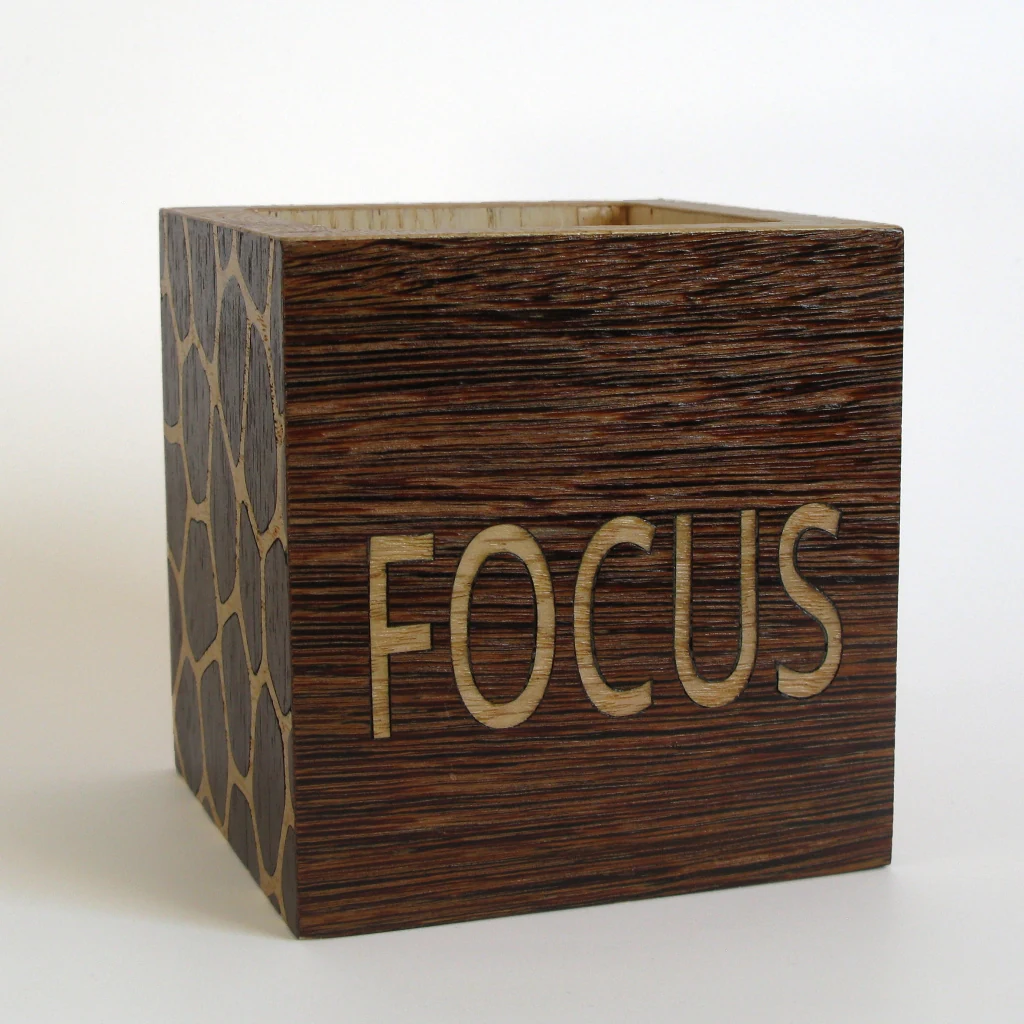
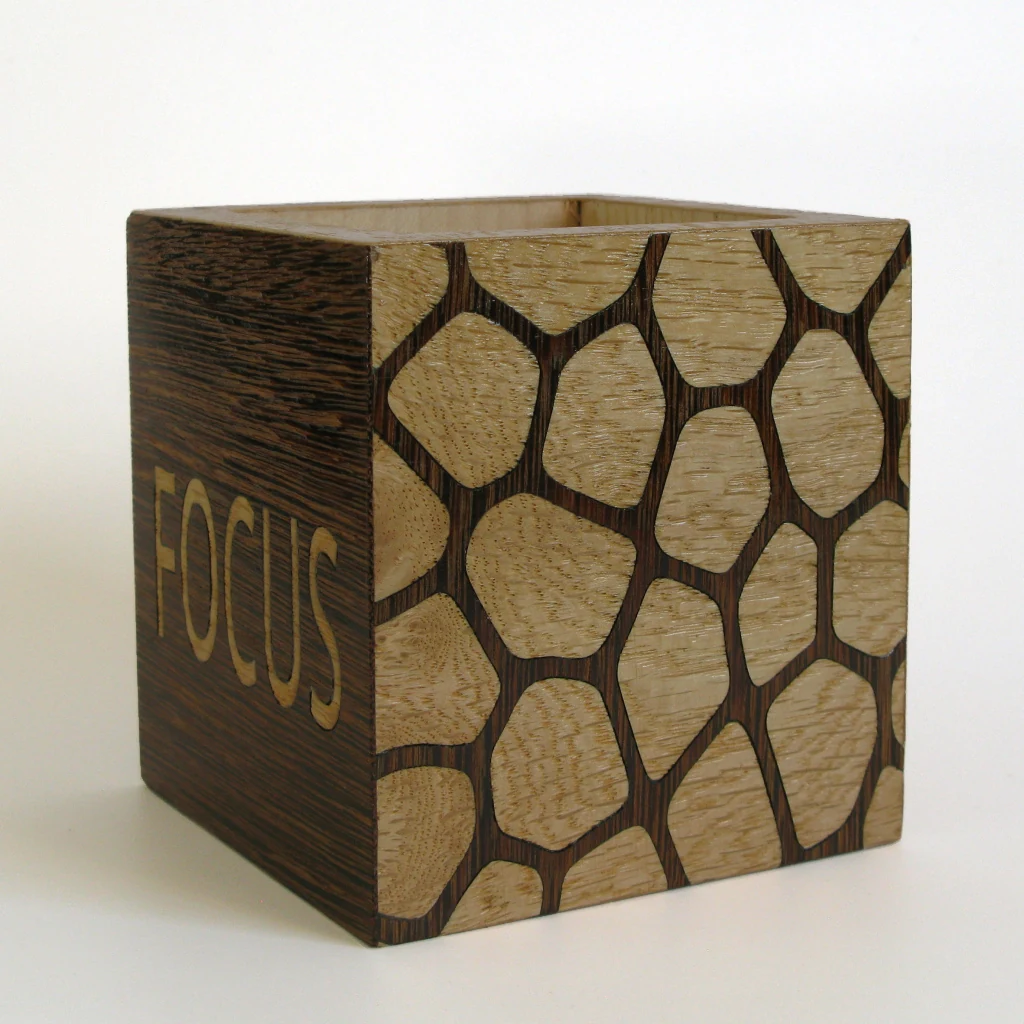
FOCUS is a handmade pen holder for the desk, made as intarsia in real wood veneer: two carefully chosen woods are cut precisely, fitted together and pressed onto a stable substrate. The pattern is not a printed picture and not a milled engraving; it is the material itself.
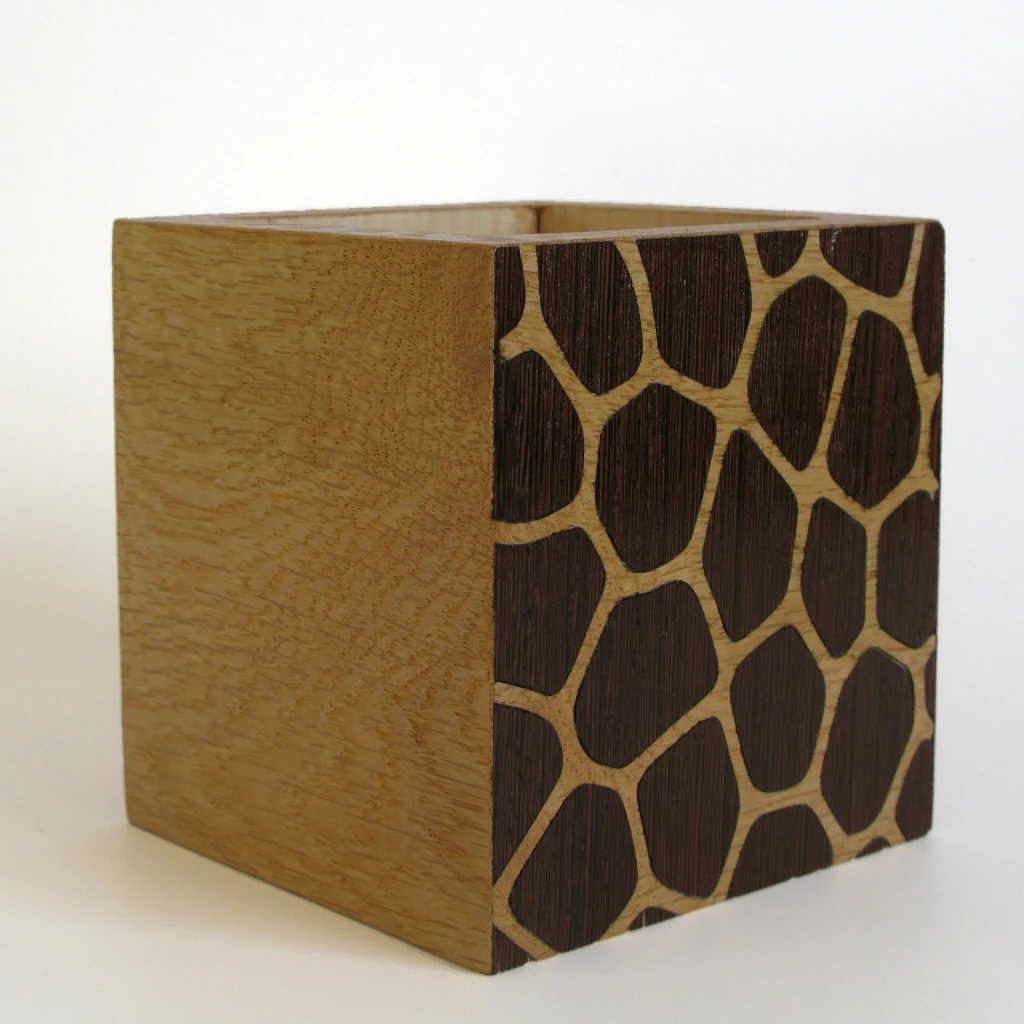
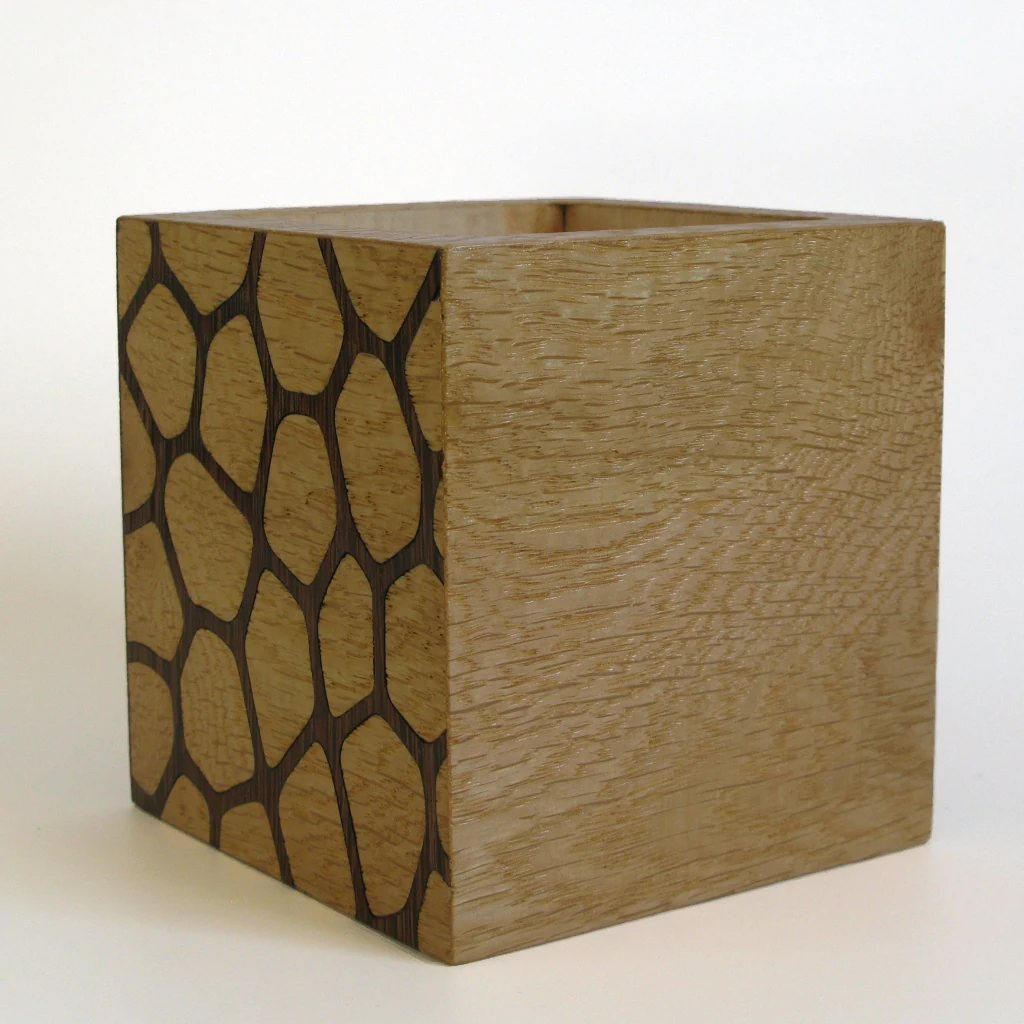
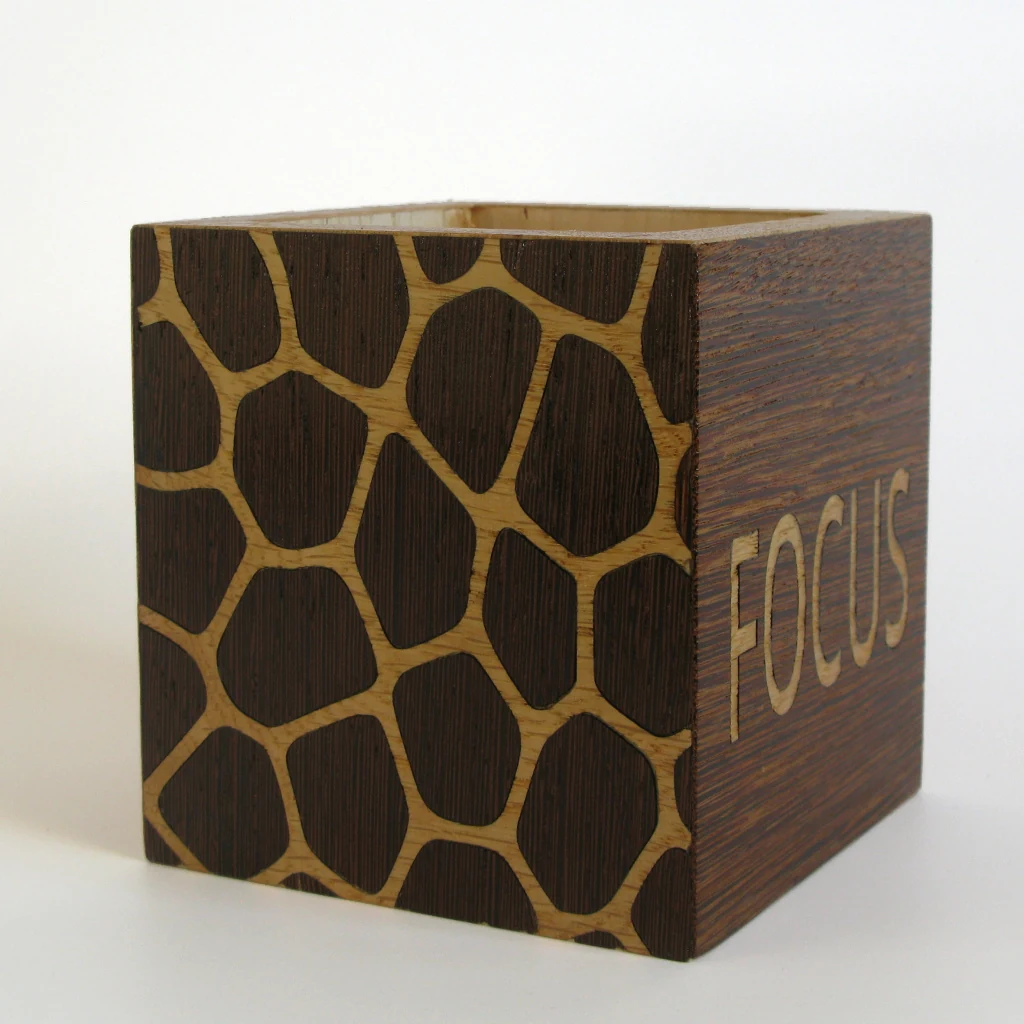
The front carries the word FOCUS, made in the second wood of the object; on the other sides a cell pattern forms the graphic counterpart. A small desk object is treated here not as a mass-market item but as a piece of precise craft. Every edge, every joint and every face of veneer is visible within a few centimetres, and up close you see the character of the wood, the quality of the joints and the decisions of the maker, not machine tolerance.
The design
FOCUS follows a clear geometry. A few strong shapes, crisp contrast and a calm overall composition make an object that reads completely on a small surface. There are no decorative flourishes; the effect comes from the pairing of woods, how the areas are divided and the direction of the grain.
Intarsia works best on small objects when the pattern is drawn bigger than the surface seems to allow; a pattern that is too fine loses its effect up close. FOCUS therefore relies on a few clearly defined contrasts that still read from the corner of your eye on the desk.
Lettering and cell pattern share the same logic: one dark and one light wood in clear contrast, with the joint between them as the drawing. The grain direction is a deliberate decision on every piece, because whether the fibres run along the shape, across it or diagonally changes how the object looks in different light. That decision is made for each variant and each batch of veneer.
Why intarsia and not print or engraving
Printed, engraved or milled wooden objects have surfaces that were worked afterwards. The base is a neutral board or a blank; the pattern is applied, not built. Up close the difference shows: printed colour has a layer edge, engraving leaves torn fibres, CNC milling leaves tool marks.
In veneer work, the pattern is the material itself. The line between wenge and oak is a hand-fitted edge between two real sheets of veneer. Under a magnifying glass it shows no layer edge, only the structure of both woods directly side by side.
The pattern changes with the light. In raking light, pores and waves of grain appear that fade in diffuse light. That liveliness is not a property of print or engraving; it is a property of real wood.
Precision on a small surface
A pen holder about 10 cm across leaves little room for error. A joint that still looks respectable on a one-metre panel is visible up close on a 10 cm object, and edges that a large surface can hide are all on show on a small one.
For FOCUS that means the whole process runs to the same standard as large veneer work, on a surface where every deviation shows at once. Cutting and fitting has to be accurate to a tenth of a millimetre, pressing must not let anything drift, and sanding has to keep the edge, not round it. The result is either clean or visibly wrong; a precision object has no middle ground.
How the pairing of woods shapes the piece
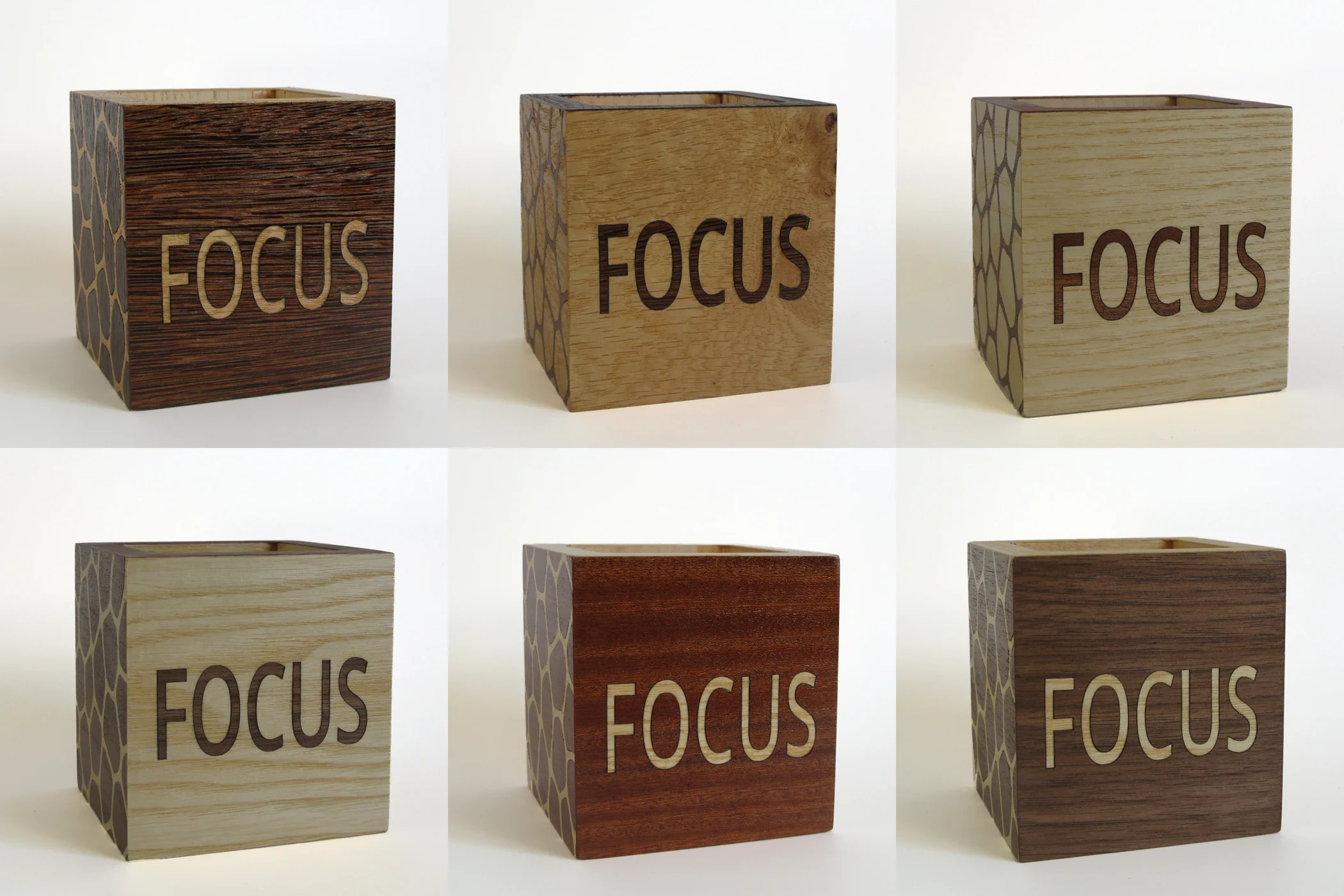
FOCUS comes in six pairings, each with its own character, colour temperature and tension. Choosing one is a decision about how the object will look where it stands.
Lightness and contrast are the most important variables. Dark bodies of wenge, mahogany or walnut carry more weight and look calmer from a distance; lighter variants with oak or ash show the pattern more openly and bring out the detail of the grain. Neither is better in itself.
Colour temperature affects how close the object feels to the room. Warm pairings with oak or walnut blend into warm settings with a lot of wood; cool pairings with ash look more precise and modern. The finish shifts it too: the hard-wax oil warms the light woods slightly.
The variants
Wenge / oak
The classic Reihax pairing. Wenge forms the body and sets a deep, almost black weight; oak gives the light lettering and the warm joints of the cell pattern. The contrast is strong, the colour temperature warm.
Mahogany / ash
A red-brown body with light lettering. Mahogany brings a warm, even colour with a fine stripe; ash sets the lettering clearly apart. This variant looks classic and warmer than the dark variants with wenge and walnut.
Walnut / ash
A dark brown walnut body with light lettering in ash. The walnut figure is lively and rich in tone, and the lettering still reads well from a distance. The oil brings out the depth of the walnut and makes the contrast richer.
Oak / walnut
The reverse: a light, warm oak body carries the lettering in dark walnut. The effect is open and crafted, and the figure of the oak stays clearly visible.
Ash / mahogany
A light ash body with dark red-brown lettering in mahogany. The cool lightness of the ash and the warm colour of the lettering give a clear contrast that suits bright, clean workplaces.
Ash / walnut
A light ash body with dark walnut lettering. The coolest variant: ash against the warm walnut, a clear difference in lightness with a contrast of warm against cool. The satin finish keeps the light character of the ash.
Light lettering or dark lettering
Variants with a dark body look calmer in dim surroundings; pores and grain stay visible, but the object does not push itself forward. Variants with a light body are more present in bright, daylight-cool offices and make the lettering easier to read from a distance.
Finish and depth
Every FOCUS variant gets the same finish: hard-wax oil, satin. How it looks still depends on the pairing, and it shapes both the visual depth and the feel of the finished object.
Oil deepens each wood's own colour. Wenge gains weight and its pores stand out more; walnut's warm browns and figure grow stronger; on oak and ash the oil stays more transparent but still adds depth. Because oil can shift the contrast between light and dark, the effect is best judged on a sample of the actual pairing.
The satin sheen matters most for the variants with ash: it keeps the cool lightness of the ash and avoids reflections that would flatten the pattern in side light. Reihax does not use shellac or lacquer; how they compare is covered in finishes for wood art and oil, wax and shellac.
Handmade versus mass-produced
Most pen holders in the shops are made of MDF, pressed wood, pressed bamboo or plastic, with patterns printed, stuck on or milled by CNC: repeatable, but without the character of wood.
FOCUS is not different in size or weight but in where every visible quality comes from. The contrast between light and dark is not paint but the difference between two real woods; the edge between them is not a printed line but a hand-fitted border between two sheets of veneer; the surface has no coat of clear lacquer but is the wood itself, oiled and satin. Picked up, moved and seen from every angle, FOCUS shows how it was made by itself.
How Reihax builds FOCUS
FOCUS is made in small batches, usually two to five at a time (small-batch production). The laser cuts the pattern pieces straight from the design file; a knife takes care of straight edges and trimming, and pieces cut with the knife get a printed paper template stuck on first.
Then the pieces are fitted by hand and taped together, one by one; assembly and sanding are the steps that take Reihax the most time. The finished veneer faces are pressed onto the substrate with PVA wood glue in a veneer press. Depending on the piece, the substrate is raw particleboard, MDF, plywood or multi-ply board (substrates).
Sanding goes on until the surface is flat, the edges stay crisp and no dark dust is left in the pores of the light woods. The finish is the same on every variant: hard-wax oil in a satin sheen, two thin coats with a light rub between them with a fine abrasive pad (hard-wax oil). After that, dusting is all the care it needs.
Size
FOCUS measures roughly 10 by 10 cm (4 by 4 in) and stands about 10 cm (4 in) tall. The exact size varies slightly between variants and batches; handmade objects do not hold industrial tolerances. The exact dimensions of the piece on offer are given on the sales listing.
Where to buy it
FOCUS is available through selected marketplaces. Current availability, variants and shipping details are on the listings.
- Amazon: the listing will be linked here soon.
- CherryCut: see FOCUS on CherryCut, where you can choose any of the six pairings and see the price straight away. The listing currently shows shipping to Germany.
For special variants, larger quantities or gift wrapping, use the contact details given on the marketplaces.
Further reading
FOCUS brings together knowledge of materials, intarsia and practice in the workshop:
- How the pen holders are made in small batches
- DEIN TEXT HIER: the same box with your own text
- THINK BIGGER, a handmade pen holder
- Ich ♥ Bayern, a handmade pen holder
- Project page: handmade pen holders
- Wood species for intarsia
- Wenge
- Oak
- Walnut
- Ash
- Mahogany
- Grain direction in intarsia
- Cutting and fitting veneer
- Gluing and pressing veneer
- Sanding veneer
- Finishes for wood art
- Oil, wax and shellac
- Caring for handmade wooden objects
Frequently asked questions
What makes FOCUS different from other pen holders?
FOCUS is handmade from real veneer as intarsia. The word and the cell pattern are not printed, stuck on or milled; they are inlays of a second wood. Each piece is real wood, and its pattern comes from combining woods, not from working the surface afterwards. Edges, joints and surface are precise handwork that you can judge up close.
Which pairing of woods should I choose?
FOCUS comes in two basic characters. With a dark body and light lettering: wenge/oak, mahogany/ash and walnut/ash. With a light body and dark lettering: oak/walnut, ash/mahogany and ash/walnut. It depends on your desk: a bright, modern workplace suits the light bodies; a warm setting with a lot of wood suits wenge/oak, mahogany/ash or walnut/ash better.
How is FOCUS made?
The pattern pieces are laser-cut straight from the design file, straight edges with a knife. The veneer pieces are then fitted and taped by hand, pressed onto a stable substrate in a veneer press and, once the glue has cured, sanded in stages. Finally the surface gets hard-wax oil in a satin finish, in two thin coats. Every variant goes through the same sequence in the workshop.
Does FOCUS need much care?
No. Keep it dry and do not use harsh cleaning products. The surface is finished with hard-wax oil; dusting with a dry cloth is all it needs, and re-oiling is not necessary in normal use. Everyday use on a desk leaves no lasting marks. The care page for handmade wooden objects has more.
How big is FOCUS?
FOCUS is a cube of about 10 cm (4 in) along each edge. The size varies slightly between variants and batches; handmade objects do not hold industrial tolerances. The exact dimensions of the piece on offer are given on the sales listing.